Wildlife on Koh Phangan: What to Spot Underwater and on Land
Koh Phangan sits within one of Southeast Asia's most biodiverse marine regions, and the island's forested interior adds a layer of jungle wildlife that most beach-trip visitors never explore. This guide covers what you're likely to encounter — above and below the water line.
In this guide +
Koh Phangan is known for its beaches, wellness scene and the Full Moon Party. What draws less attention is the range of wildlife you can encounter during a stay — both in the reefs that ring the island and in the forested hills that cover much of its interior. The Gulf of Thailand supports a rich marine ecosystem, and Koh Phangan's position within it means that a snorkel or dive, a jungle walk, or even a slow afternoon at a quiet beach can produce genuinely surprising wildlife encounters.
This guide covers the most commonly spotted species — what they are, where to find them, and the best way to look without disturbing them. None of the sightings described here are guaranteed; wildlife operates on its own schedule. But knowing what is present and where it tends to be found changes how you move through the island, and makes the difference between noticing something remarkable and walking past it.
Marine life: reefs, rays and reef fish
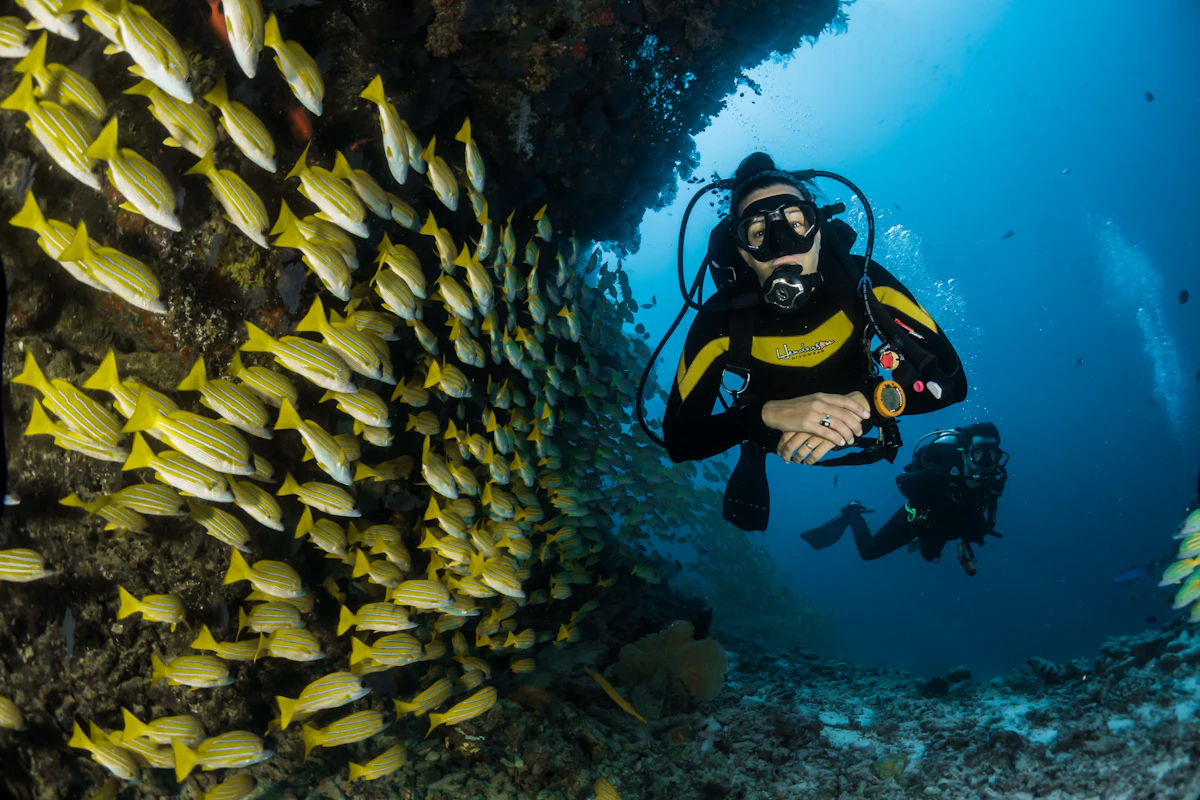
The shallow reefs around Koh Phangan are home to hundreds of reef fish species. The Koh Ma reef at Mae Haad beach is the most accessible — a well-preserved coral reef reachable by a walk across the sandbar at low tide or a short swim. Parrotfish, surgeonfish, triggerfish, butterflyfish and schools of blue-striped snapper are regular sightings. Moray eels shelter under coral heads. Cuttlefish hover in the shallower zones and are among the most rewarding animals to observe calmly — they change colour in real time when approached slowly and patiently.
The reefs off Haad Salad and Haad Yao on the west coast support similar communities of reef fish, with the additional chance of seeing bumphead parrotfish, which travel in small groups and can be heard grinding coral before they are seen. Haad Khom on the north coast has a healthy reef that sees less traffic than the west-coast sites and rewards the extra travel time.
For rays, the sandy flats near Mae Haad and the shallower bays on the west coast occasionally produce blue-spotted stingrays resting in the sand — the electric-blue spots on a brown body are unmistakable once you know what to look for. They are docile and present no danger if not touched or disturbed.
Whale sharks and larger pelagic species
Whale sharks — the world's largest fish, filter feeders that pose no threat to humans — are the most talked-about wildlife encounter in the waters around Koh Phangan. They visit the Gulf of Thailand and are associated most strongly with the open-water dive site at Sail Rock (Hin Bai), roughly two hours by boat from the island. Encounters are most likely in the drier months when plankton blooms bring them close to the surface, but they are inherently unpredictable: no dive operator can guarantee a sighting, and any that does is overpromising.
What makes a Sail Rock dive trip worthwhile regardless of whale sharks is the site itself — a large isolated pinnacle that draws blacktip reef sharks, barracuda, grouper and great schools of fusiliers, with a distinctive chimney passage through the rock that requires controlled buoyancy and rewards the effort with fish in every direction. Sail Rock is consistently rated among the best dive sites in the Gulf of Thailand.
Bullhead parrotfish, trevally, and — with luck — occasional sightings of thresher sharks at depth are also part of the Sail Rock catalogue. The dive is suitable for open-water certified divers and above.
Chaloklum Diving
Chaloklum Diving is a PADI dive school and scuba operator in Chaloklum on the north coast of Koh Phangan.
Sail Rock Divers
A PADI scuba diving center on Koh Phangan running guided dive trips and courses to Sail Rock (Hin Bai).
Haad Yao Divers
Haad Yao Divers is a scuba diving center at Haad Yao beach on the west coast of Koh Phangan.
Monitor lizards and reptiles on land
Water monitors (Varanus salvator) are the most visible large reptile on the island and throughout coastal Thailand. They are common, unhurried, and large — adults regularly reach one to two metres in length, occasionally more. They are frequently seen near water: along riverbanks, at the edges of ponds, and crossing roads or paths in the forested interior. Despite their size, they are not aggressive toward people and will move away if approached; the sensible practice is to give them space and observe from a few metres.
Smaller lizards are everywhere in the jungle and around accommodation: geckos on walls and ceilings at night, skinks on sunny rocks and paths during the day, and the occasional garden lizard — the males in breeding condition are unmistakable, with a bright orange-red head and throat. Tree lizards and flying lizards (Draco species) inhabit the forested interior and are worth looking for on the branches of larger trees in the hills above the west coast.
King cobras and other snake species are present in the island's forested interior, but encounters are rare and the snakes are far more interested in retreating than in confrontation. Standard jungle precaution — watch where you step, don't reach into holes or under rocks — is sufficient.


Birds: hornbills, kingfishers and jungle species
Koh Phangan's forested interior supports a range of bird species that most visitors never seek out but often stumble across. The most distinctive is the wreathed hornbill — a large, dramatically crested bird with a yellow casque on its bill, identifiable by its loud wingbeats as much as its call. Hornbills are most often seen in pairs or small groups moving between fruiting trees in the forest canopy. Khao Ra, the island's highest peak, and the forested hillsides above Sri Thanu and Chaloklum are the most productive areas.
Common kingfishers are found along the coastal edges and freshwater streams — their electric-blue and orange plumage and rapid flight over water make them easy to identify once seen. Oriental pied hornbills, which are smaller than the wreathed, are more commonly spotted at forest edges. Brahminy kites and white-bellied sea eagles are the raptors most often seen soaring over the coast and the interior, particularly around Koh Ma and the northern headlands.
Migrant waders appear on the tidal flats and quieter beaches in the wetter season, adding variety to any birding walk along the shore. The island is not a formal birding destination with infrastructure to match, but the species richness of a Thai coastal forest — hundreds of species within range — makes quiet observation rewarding for anyone who pays attention.
Jungle mammals: macaques and nocturnal species
Long-tailed macaques (Macaca fascicularis) are the most commonly seen mammals on the island. Family troops move through the forest edges and occasionally along the roads and at fruit stalls in the more rural parts of the island. They are habituated to people but are wild animals — feeding them is discouraged, as it alters their behaviour and creates dependency. Watching a troop from a respectful distance, particularly with young in the group, is an experience that needs no intervention to be compelling.
Slower-moving and harder to find, palm civets and other small nocturnal mammals inhabit the island's forest but are rarely seen without deliberate night-walk activity. Bats are common at dusk around fruiting trees and over the coastline; the island's tropical forest supports several species, and an evening walk in the hills often produces bat activity in quantity.
Malayan porcupines, wild boar and small deer are present in the deeper forested areas but rarely seen by casual visitors. The best chance of encountering them is on early-morning walks in the interior, well before the heat of the day, when mammals are more active and the forest is quieter.
Ang Thong Marine Park: a protected marine ecosystem
The Mu Ko Ang Thong National Marine Park, accessible by day-trip boat from Koh Phangan, is a protected archipelago of 42 limestone islands roughly 30 kilometres to the west. The park's reefs, seagrass beds and open-water channels support a marine community that benefits from the protection — dugongs, dolphins and sea turtles are more likely to be encountered here than in the unprotected reefs closer to the island.
Indo-Pacific bottlenose dolphins and short-finned pilot whales are occasionally seen in the waters around the park; sightings are not guaranteed but are a real possibility on any boat crossing in the right conditions. Hawksbill and green sea turtles nest on some of the park's beaches, and while nesting activity is carefully managed, sightings of turtles in the water during a snorkel are possible at the right sites.
The park's coral gardens have recovered more than reefs subject to continuous visitor pressure, and a snorkel at one of the protected sites is noticeably different from the accessible reefs close to the main island — more intact, less disturbed, and with a higher density of fish. The day trip involves an early start and a full day on the water; it is one of the most wildlife-rich activities available from Koh Phangan.
Good to know
- Are whale sharks guaranteed at Sail Rock? +
- No. Whale shark sightings are inherently unpredictable, and any operator who guarantees one is overpromising. They are more frequently encountered in the drier months when plankton conditions favour their presence, but they move on their own schedule. Sail Rock is worth diving regardless — the site is exceptional for reef sharks, barracuda and schooling fish even without a whale shark encounter.
- Are the monitor lizards dangerous? +
- Water monitors are large but not aggressive toward people. They will typically move away when approached. Give them space, do not attempt to touch or corner them, and they present no meaningful risk. Their saliva contains bacteria, so a bite — which would require genuinely provoking the animal — warrants medical attention. In practice, the lizards are far more interested in fish scraps and unattended food than in interacting with people.
- Where is the best snorkelling for reef fish near the island? +
- The Koh Ma reef at Mae Haad beach is the most accessible and consistently good reef close to the island — reachable by sandbar walk at low tide or a short swim. Haad Salad and the reefs off Haad Yao are also productive and less crowded than the Mae Haad site. For the best marine biodiversity, a day trip to Ang Thong Marine Park or a dive trip to Sail Rock reaches reefs in better condition than those immediately adjacent to the main island.
- Can I see sea turtles while snorkelling on Koh Phangan? +
- Sea turtle sightings around Koh Phangan are rare but not impossible — occasional encounters at deeper reef sites and around the Koh Ma area have been reported by divers. Sea turtles are more reliably encountered in the Ang Thong Marine Park, which is a protected area with less boat traffic and higher marine biodiversity. If a turtle encounter matters to you, a day trip to the park gives the best realistic chance.
- Is there good birdwatching on Koh Phangan? +
- The island has a good range of species for casual birdwatching: hornbills, kingfishers, Brahminy kites and white-bellied sea eagles are reliably present and visually striking. The forested hills above Sri Thanu and the Khao Ra summit trail are the most productive areas. Koh Phangan is not a formal birding destination with infrastructure for serious twitching, but anyone who moves quietly in the forest at dawn or dusk will find the bird activity genuinely rewarding.
- What should I do if I encounter a monkey? +
- Observe from a comfortable distance and do not offer food. Feeding macaques creates dependency and can make them approach or follow people aggressively when food is not forthcoming. Do not make direct eye contact for prolonged periods — in primate body language, a sustained stare is a challenge. Keep bags closed and food out of sight. If a macaque approaches, calmly move away rather than running.
Last updated 17 July 2026 · places shown are real listings with live Google ratings.